

How much homework should my young person be doing?
Homework, a word that causes stress and anxiety for parents, teachers and young people!
Are they getting enough? Are they getting too much? These can be tricky questions to get a definitive answer to, so today I’ll discuss what the purpose is and what you can do to support your young person. There is a wider debate about whether homework should be given or not and I won’t go into that today.
If you are unsure if they are getting the correct amount of homework, the first step is to see how your young person’s homework compares to the school homework policy. You can usually find this in their documents or on their website. If you think that the experience of your young person doesn’t match the expectation then discuss it with the teacher or head of year.
What is the purpose of homework?
Getting your young person to understand the purpose of homework can give them some added motivation when it is a slog! Homework should be seen as an opportunity not a chore.
Extra curriculum time
Schools have to work through a lot of topics, this increased when the curriculum was changed a few years ago, so it’s really important that there is time for work outside of school hours, or they won’t do as well as they would otherwise.
A chance to practice maths concepts until they are fully embedded
One of the things with maths is that you need to ‘practice not until you get it right, but practice until you can’t get it wrong’ . There isn’t time to do enough practice in school, so often homework is that practice. This means that if your young person doesn’t understand the topic, you need to find an explanation first. I recommend finding a youtube video that explains it, or ask the teacher to send an explanation.
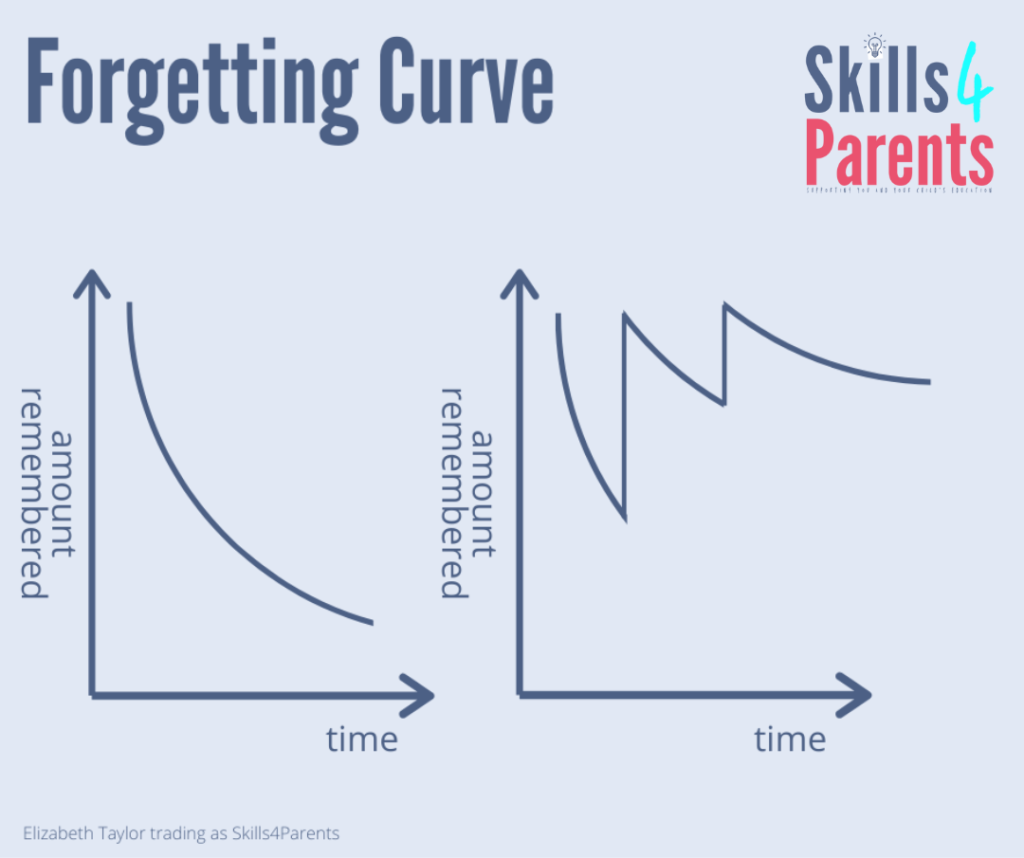
Minimises the forgetting curve
We all forget things, but by repeating whatever it is you are learning you begin to forget it less. Start the repeat after a short period of time and then make the gaps longer. Homework is often used as a way of repeating topics.
Independence and organisation
Being able to work independently and organise themselves are useful life skills. Not every young person manages it, but with encouragement and guidance homework can be a great way to teach them.
How much homework should they get?
This is age dependent, and also varies on the school and ability.
These would be my guidelines:
- Primary : 10 minutes a day. Reading, learning spellings, learning times tables and practicing sums. It’s important to learn maths words too. Some primary schools
- KS3 30 mins – 1 hour a day
- GCSE – 1 – 2 hours a day
If you find that your young person is struggling with their homework and it is taking too long then I recommend talking to the school.
If they are not being set enough homework or finishing it too quickly you can either discuss it with the school or set them extra work using some of the resources I listed here.
Homework can be stressful and next week I will be looking at how to take the stress out of homework. If you want advice then remember you can book a 1:1 call with me.