
Why Your Child is Forgetting Things…And What You Can Do About It
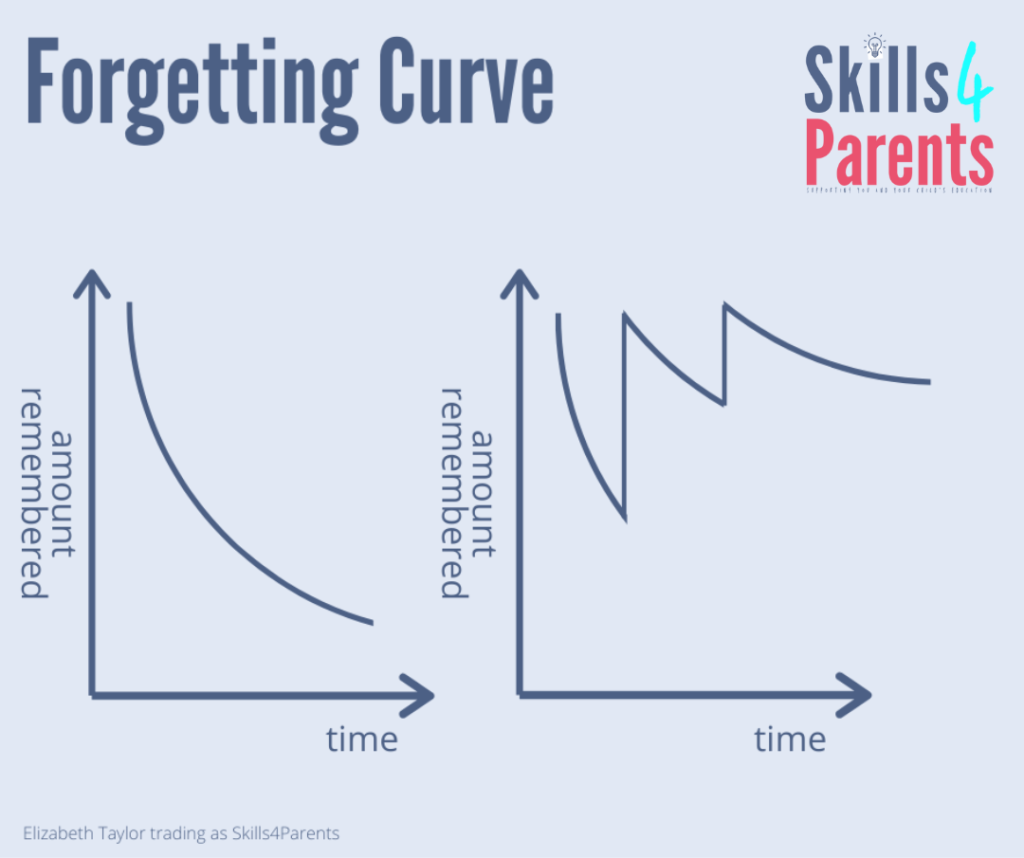
Using forgetting to your advantage
Do you find that when you learn something you then forget it and need a reminder? It might surprise you to learn that that is how our brains are wired! Did you know that research shows that within one hour you forget 50% of what you learn? It might seem pointless therefore to learn, but how do we learn to remember what we are taught?
The Forgetting Curve
Hermann Ebbinghaus was a German Psychologist in the late 19th century who studied memory and discovered the forgetting curve and the spacing effect.
What he found is, when you learn something, you forget it in a curve, when you then learn it again the curve is not as steep, by spacing out the repeats further and further apart you can get to a point where you don’t really forget it.
You need to keep going over things so that they get embedded in your memory and you are able to recall it really easily. You’ll see from the curve the more times you go over something the easier it is to remember it.
Applying this to learning
You can use the forgetting curve to help you understand how to revise effectively. You need to make sure that you go over the things that you have forgotten and that you do this regularly. Start early and use your learning styles to plan your learning. If you are a visual learner then you can create visuals that
If you don’t know what your learning style preferences are, you can get a learning style quiz as part of my guide here.
-
£7.99A Guide to Learning Styles This 27 page downloadable book explains three learning styles to help you understand your young...
Don’t leave it to the end of the year
Whatever year group your young person is in they need to repeat their learning. Some of the ways you can do this are:
- After they have learnt a topic do a couple of questions on it with them. Two weeks later do another couple of questions three weeks later again to another couple of questions and so on.
- Keep record cards with what they’ve learnt and get them to go over a few of them each day. As they keep going the pile gets bigger but they keep going over it and the distance between the learning increases.
- Buy some workbooks and get them to do a little bit each week.
- There are plenty of websites. And apps with games for different areas of maths so use some of these to go over some of the maths I’ve been taught.
I’ve written some handy guides to the books, websites, and apps that you might use. You can get them in a handy bundle for £9.99 here.
How are you going to implement regular revision in learning at home? Come and tell us in our FREE Facebook group where we provide skills for parents and education advice: