
Want to Improve Your Maths? Start Here.
When you think of Maths what do you think of? For a lot of people it’s numbers, for others it’s algebra. This month I want to think about the 4 areas of Number, Algebra, Geometry and Statistics, which make up the English maths curriculum. Understanding the make-up of these topics will help with maths GCSE, as you can work out weak areas and focus on them. It’s essential to have a firm foundation to work from.
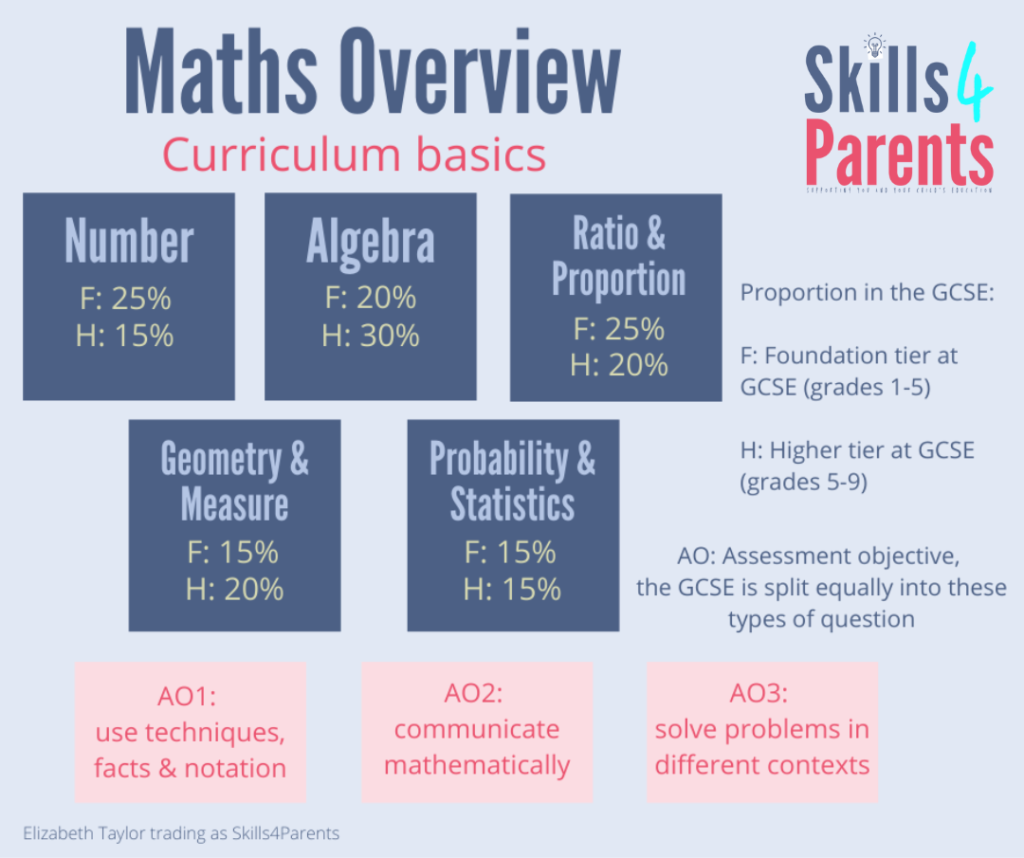
This week I want to consider number, this is the area of maths that most people in England are strongest at, as we spend much of our learning time on it. The Maths GCSE at foundation is made up of 50% number, and at higher tier it’s 30% number. It’s important to focus on ratio and proportion as part of this, because this makes up over half of the number topic!
Let’s look at the make-up of the area of number, I’ve written them in the order that I would focus on.
Calculations
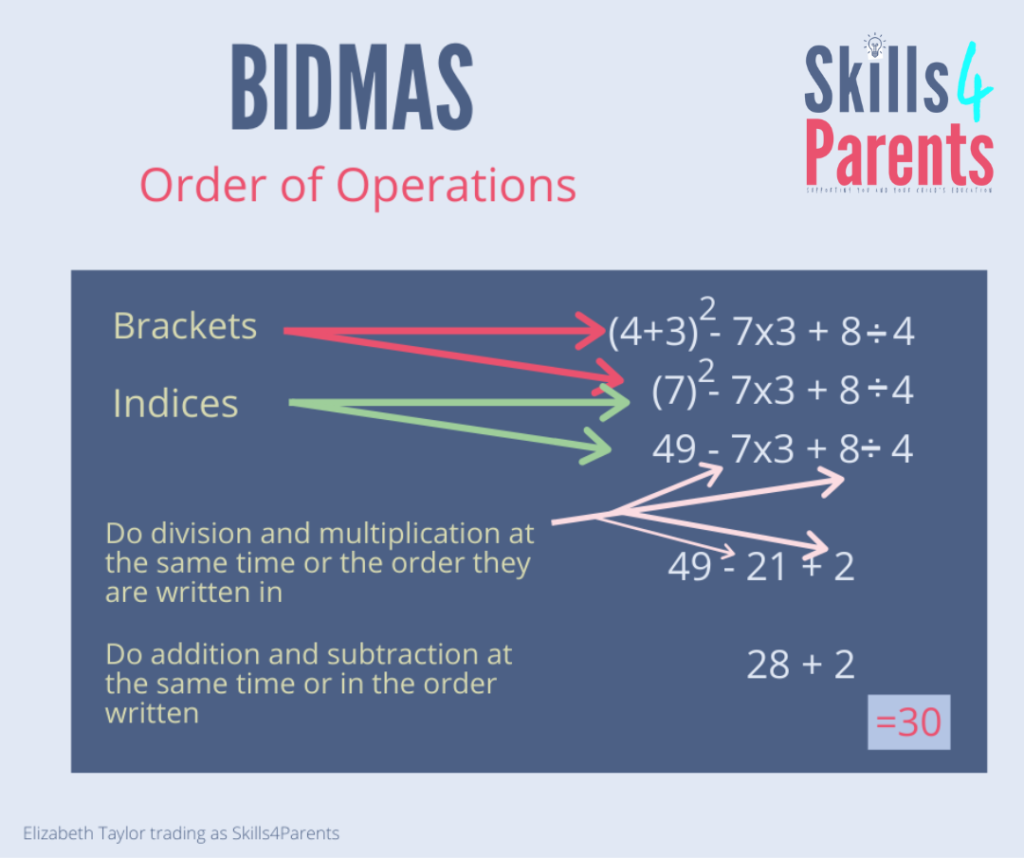
This encompasses the times tables, addition and subtraction, division etc, there is one area ‘order of operations’ (also known as BIDMAS, BODMAS, PEDMAS..), doesn’t get taught until late primary, but this is really important as it is the basis of all calculations. Young people often don’t understand that where you have only ‘division and multiplication’ or ‘addition and subtraction’ they are calculated in the order in the calculation, rather than in the order ‘addition then subtraction.
Fractions, Decimals and Percentages
Does your young person understand what a fraction is? They need to comprehend that the ‘denominator’ (the bottom number) is what the ‘whole’ is cut up into, and the ‘numerator’ (the top number) is how many parts they have.
Having a grasp of the equivalence of fractions, decimals and percentages will give them the skills to use decimal multipliers for percentages and have a deeper understanding.
Moving into more challenging maths with percentages is interest rates and knowing the difference between.
Ratio and Proportion
To get to grips with ratio and proportion there needs to be a solid understanding of fractions, decimals and percentages. With ratio and proportion taking up 25% of the foundation GCSE and 20% of the higher GCSE, it’s a topic that is worth spending time on.
There are great opportunities here for real life maths, including multiplying recipes up and down, sharing money in a given ratio and working out what to buy for the best value.
Indices and Powers
A much smaller topic but just as important, an index number or indices are powers, where a number is multiplied by itself.
They must memorise square numbers to 12 squared, and cube numbers to 5 cubed, and be able to perform calculations with indices. If they are struggling to understand the index rules for calculations, then I find it helpful to write it out and demonstrate how it simplifies.
Approximation and Standard Form
Getting used to estimating calculations will enable your young person to know if an answer is correct or not. When estimating they should round each number to 1 significant figure. Make sure they understand the difference between decimal places and significant figures.
Standard form is a way of writing large or small numbers which is often used in physics. Knowing the index rules, will enable your young person to be able to do calculations with standard form.
This is one of my favourite videos explaining standard form:
By improving your knowledge across these core aspects of number, you set yourself up for success across all areas of maths. You’ll be sick of my brick wall analogy but it is an incredibly accurate representation of how the foundations play into the more complex topics.