

Don’t Be Fractious When It Comes to Fractions!
This week we are looking at circles and fractions, because it’s British Pie week, and next Monday is pi day! Each week over the next couple of months we will focus on a different area of maths, and I’ll give you some of my top tips for each of topic.
The Language of Fractions
Maths is a language and so it’s important to understand the meaning as well as the words. Here’s the way I explain the key words in fractions to my students:
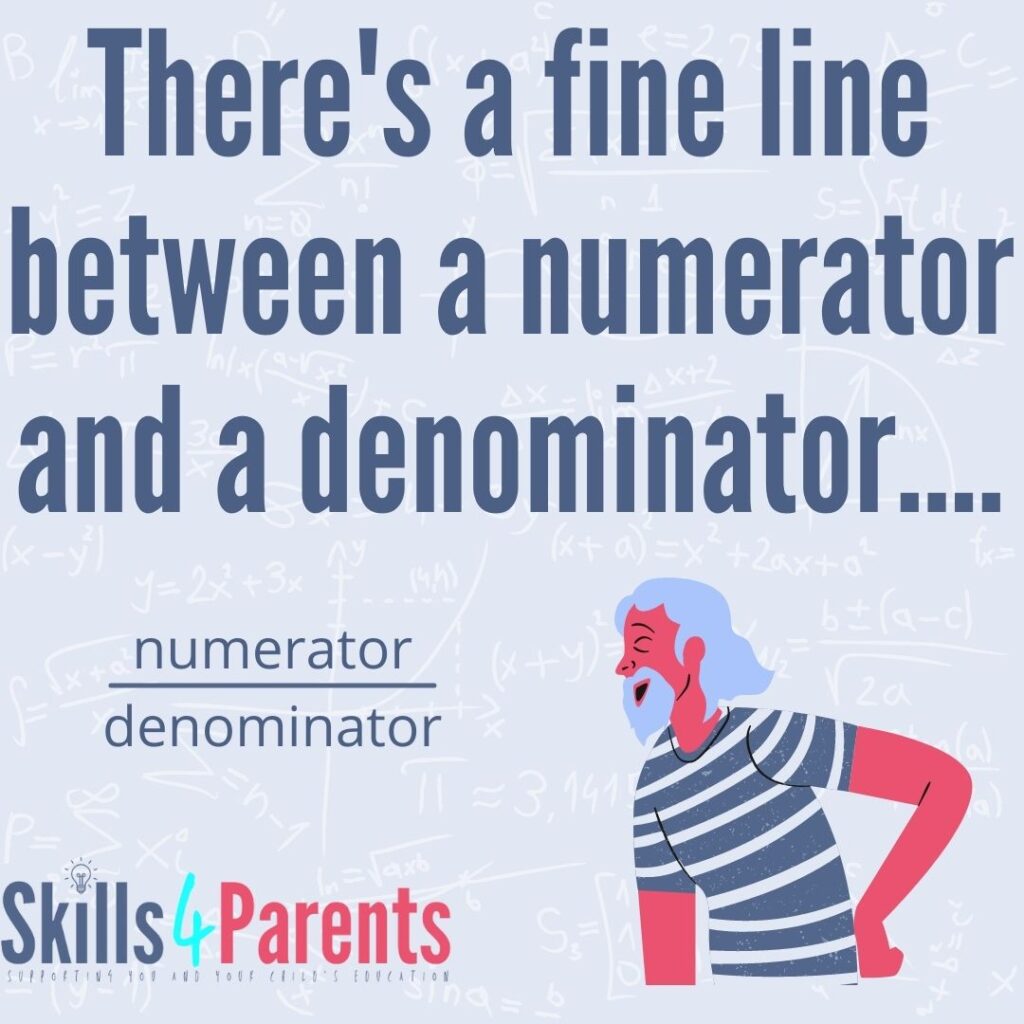
Numerator:
Memory hook: sounds a bit like number-top and it’s the top number
Meaning: the number of parts that you have
Denominator:
Memory hook: sounds a bit like derriere and it’s the bottom number
Meaning: the number of pieces each whole is cut up into
Improper Fraction
Memory Hook: A fraction that isn’t very nice (Improper)
Meaning: A top heavy fraction, where the numerator is larger than the denominator
How to help your child with Fractions at home:
Fractions are a great topic to work on at home, because you can just talk about them whenever they occur. For example:
- When cutting up portions of food, you can make the connection to the fraction and the meanings of numerator and denominator
- If you cook more than one pizza/cake/pie you can do conversions between improper fractions and mixed numbers
- Demonstrate fractions that are the same for example cut a pie into quarters, and then half each quarter, you can then explain that a half of a quarter is an eighth as you now have 8 pieces, and that your quarter is the same as 2/8
Ideas for each of the different Learning Styles:
Everyone benefits from using each learning style in their learning. Your child may have a preference, and therefore weight what they are doing towards their preference (but don’t be exclusive with it). If you want to find out more then you can get my FREE eBook, A Guide to Learning Styles: VARK
Visual:
- use fraction walls to understand equivalence of fractions, there are lots on the internet if you search for them
- Draw circles to represent a whole and divide up into fractions
Auditory:
- Demonstrate and explain what you are doing
- Whilst they are working on fractions in real-life get them to explain what they are doing and read it out loud
Reading/Writing:
- Demonstrate what to do by doing examples and get them to write it down
- I recommend maths drills https://www.math-drills.com/fractions.php. when your child needs a bit of practice on any fractions topic you’ll find a sheet here. Remember what we say, don’t practice until you get it right, practice until you never get it wrong
Kinesthetic:
- Use physical resources to help them move fractions about and play with them.
- The Dyslexia Shop has some magnetic fraction tiles, great for kinesthetic and visual learners, and has both pie-style fractions and lengths.
- Equivalency rods can help with understanding equivalent fractions and decimals, as well as helping with an understanding of the concept of fractions
How do you feel about fractions?
Your understanding will change the conversations that you have with your child about them.
I love this video about ‘What I Wish I’d Learnt at School’
If you need more help then get in touch, I’m here to help you understand the maths you need to support your child, and don’t forget to join Education Support 4 Parents my free Facebook group.