
How to Conquer Pi with Your Child
This week we celebrated Pi day, whereas last week was British Pieweek! Pi day or 14th March, (written in American date system as 3/14), because Pi is 3.14 . We are looking at different areas of maths each week over the next couple of months, and as we celebrated pi day, I figured we’d think about circles and how pi relates to them. Do you know how to help your child find the area and circumference of a circle?
What is Pi?
Pi is just a number, it’s a strange number, but it is JUST a number. Why is it special? Because it’s the ratio of the circumference to the diameter.
There’s a great activity that you can do with your child to get an understanding of what Pi is, and where the formula for the circumference comes from. You can draw lots of circles and measure their diameter, and then by laying string out around the circumference you can work out the length of the circumference. If you then get them to divide the circumference by the diameter, they should get about 3. You can get them to do many and average them out, to see how accurate they can get their calculation. This activity is great for kinesthetic learners, as it is hands-on.
Pi is an irrational number, that means it cannot be expressed as a fraction and it does not repeat, but does go on forever. Super computers continue to calculate it to as many decimal places as possible, and have now done so to 62.8 trillion digits…. there is no reason for doing this, other than they can!!
Language and Words
It’s always important to learn the language of an area of Maths, as without that maths is just gobbledy gook (and I promise you it doesn’t need to be!). So here are the key words and their meanings:
Circumference – perimeter of a circle (distance around the edge)
Radius – distance from the centre to the rim of the circle
Chord – a line from a point on the circumference to another point on the circumference.
Diameter – a chord that passes through the centre. The prefix ‘dia’ means through or across, just like the word diagonal.
Segment – think orange segment this is the area bounded by a chord and the circumference
Sector – an area bounded by two radii (the plural of radius!) and the circumference, how we often cut cake! You can use cut and sector to help your child remember this one.
Arc – part of the circumference
Learning the Formulae
To find the area and circumference of a circle your child needs to know the formulae. Depending on their learning style preferences there are a few ways that you can do this with them.
Use Songs
Great for auditory learners this song is really good for remembering the area and circumference of a circle. Play it everyday and annoy your children but they’ll never forget it!
From the song you can repeat:
‘Pi r squared sounds like area to me. When I need the circumference I will use Pi D.’
Use Mnemonics
Mnemonics are great for learners where their preference is reading/writing. One of my favourites for these formulae is:
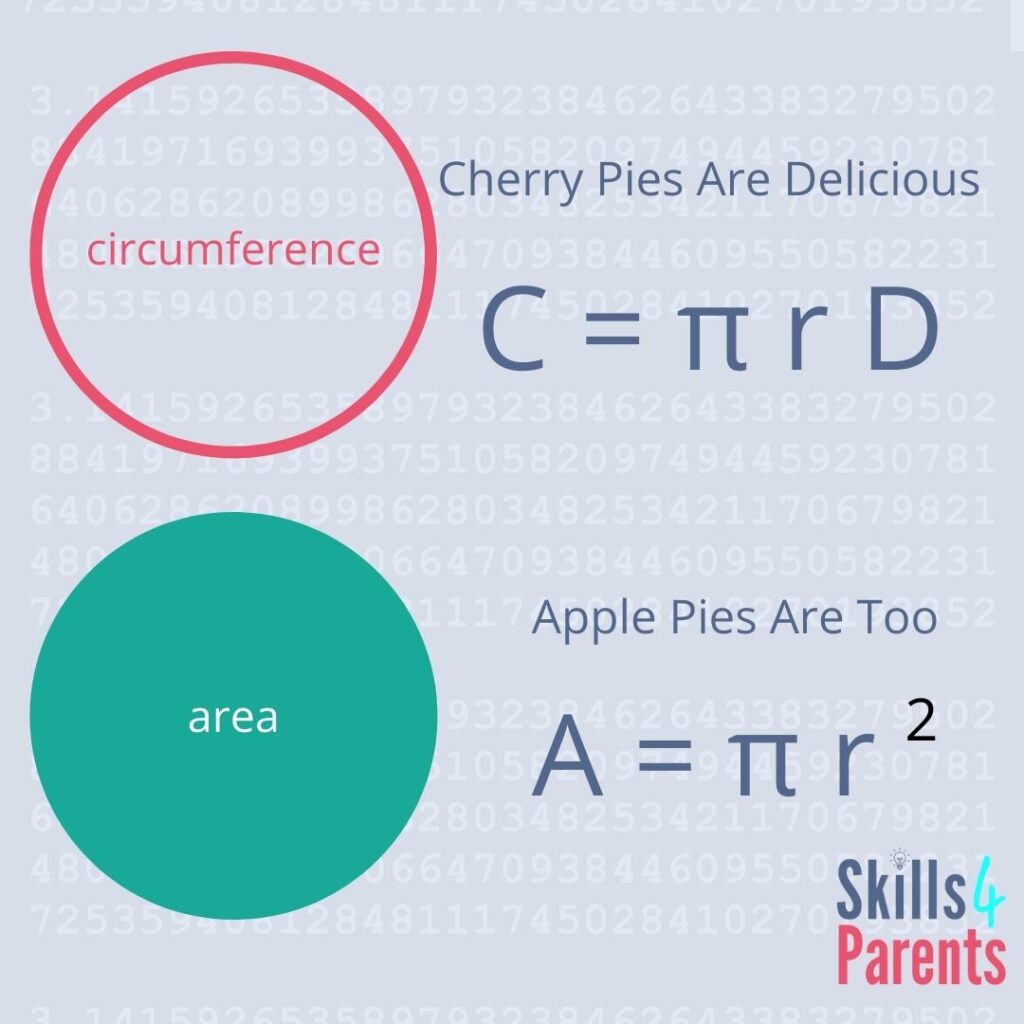
Cherry (C) pies’ (?) delicious (d)!
Apple (A) pies (?) are (r) too (2)!
Where next?
At Skills4Parents we often talk about ‘the wall’, with circles and pi they are the foundation for some other areas of maths. This is why it’s important to fully understand them as the rest becomes wobbly.
Further up the wall they need to find an arc length using proportions of the circumference, and the area of a sector using proportions of the area of a circle. There is also surface area and volume of cylinders, cones and spheres, and shapes made up of parts of them.
If you need support with any of this, or other areas of maths, you can find us in Education Support 4 Parents.